
FCDC Release Destinations
FCDC staff duties include booking, releasing, and transporting people outside the facility. A departure can therefore mean a community release after bond, dismissal, time served, probation, or sentence completion. It can also mean transfer to another jail, a Kentucky Department of Corrections institution, federal custody, or another authority. Ask for the exact release type and receiving agency.
For a true local release, match three records. The FCDC release sheet should give the physical date, time, and coded reason. The Fulton court docket or order explains the legal authority. Kentucky VINE can add a custody event. When the person was held in a state corrections bed, add KOOL and the dated DOC Daily Releases report. A transfer is not release to the community.
| Departure | Best record | Next check |
|---|---|---|
| Bond or court release | FCDC transaction | Fulton court order and VINE |
| State release | DOC Daily Releases | KOOL status and supervision |
| Transfer | Receiving-agency field | New custodian's locator |
Confirm FCDC Inmate Release
The official Current Inmates page embeds a roster labeled Fulton County Regional KY. It is useful for present custody but does not publish a verified release archive. Roster removal can reflect release, transfer, correction, or data lag.
- Record the exact name, booking number, and time of the roster check.
- Call FCDC at 270-236-2405 and ask whether release processing finished.
- Ask for the release type, date and time, and receiving agency if transferred.
- Check Kentucky VINE for the event.
- Read the Fulton court order, then add KOOL for a DOC inmate.
The full named-person search route appears on Fulton County Released Inmates. Use identifiers, not a photograph alone, when two records share a name.
FCDC Records And Contact
The elected Fulton County Jailer operates FCDC. The county Jailer page lists the office at 2008 South Seventh Street, while the detention center website uses 2010 South Seventh Street for the physical facility. Those addresses should not be treated as interchangeable mailing directions. The jail publishes a separate inmate-mail address, which is not a release pickup point.
Fulton County Jailer / FCDC2008 South Seventh Street, Hickman, KY 42050
Detention building: 2010 South Seventh Street
270-236-2405 · Fax 270-236-9140
steve@fultonkyjail.com
Listed office hours: 7:00–3:00
Ask the Jailer who serves as records custodian and which submission method is accepted. A narrow request should identify the person, booking number, and date range, then name the booking record, release sheet, release time, coded reason and definition, transfer destination, and booking photograph. The county open-records channel covers Judge-Executive records, but a separate elected office may route its own requests. No verified FCDC copy or booking-photo fee was found.
FCDC County-State Overlap
FCDC is a county/regional jail for men and women, yet its role extends beyond short local detention. A Kentucky DOC weekly report dated August 14, 2025 listed 415 people, including 296 Class D inmates, 80 controlled-intake inmates, and ten parole violators. That composition explains why a Fulton County search often becomes a Kentucky DOC search.
A Class D or controlled-intake person may remain physically at FCDC while being tracked by the state. KOOL can show sentence calculations, a current location, a parole action, or later supervision. A dated DOC Daily Releases report may list Fulton County Detention Center as the releasing location. Conversely, a local pretrial detainee released on bond may never have a useful KOOL record.
- Controlled intake
- A state-tracked person awaiting classification or placement.
- Parole
- Community supervision following a Parole Board release decision.
- Transfer
- Movement to a new custodian, not freedom from custody.
- Detainer
- A hold from another authority that can block or redirect release.
FCDC Capacity Records Differ
Two official FCDC capacity figures coexist. The jail homepage calls the facility a 525-bed jail. The dated August 2025 DOC weekly report lists 449 total jail beds. No reviewed source explains the difference.
Preserve the source and date whenever either figure is used. The variance may concern reporting scope, classification, or timing, but those are possibilities rather than verified explanations. This distinction matters because the same discipline applies to release data: a live roster, a weekly population snapshot, and a release transaction describe different facts and different moments.
The official FCDC homepage is shown below as a source for facility contact and staff functions.
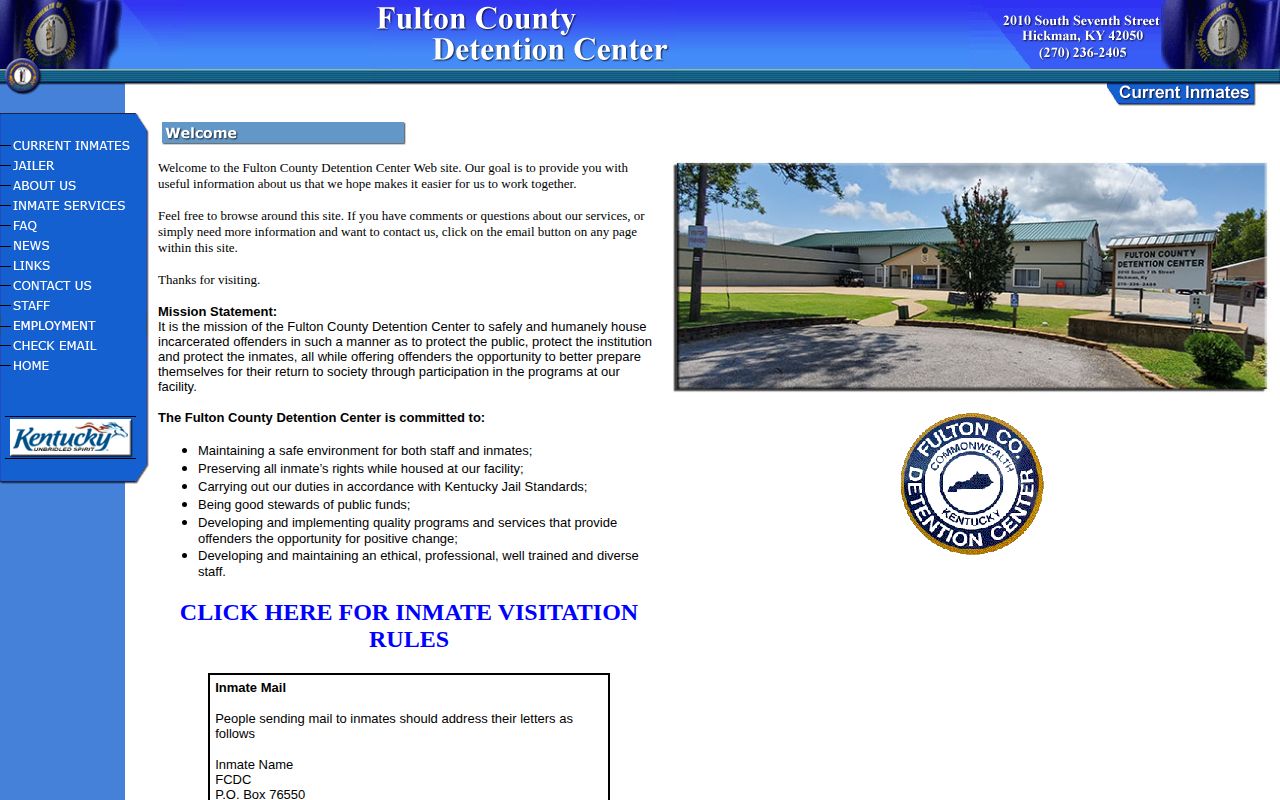
The image documents the facility source, while case-specific release status still requires a current check.
FCDC Release-Day Logistics
No official public rule was located for release hours, weekend or holiday processing, exit point, family waiting, transportation, or personal-property pickup. The posted office hours do not prove when physical release can occur. Call FCDC for instructions tied to the named case.
Physical release can follow a court order only after staff complete identity, hold, detainer, and property steps. A documented order may explain why release was authorized without proving the minute the person left. Likewise, a ride or planned destination does not prove arrival or completion of parole conditions. The jail-door event and post-release supervision are separate facts.
For continued state control, consult Post-Release Supervision. For an estimated state sentence date, use Release Date Lookup.
FCDC Release Record Fields
A useful FCDC request asks for fields, not a vague statement that someone is gone. Name the booking number, admission date, release time, release type, coded reason and definition, court authority, and transfer destination. Ask whether the transaction marks community release or movement to a new custodian. Name the booking image separately if needed.
The court and jail records serve different roles. A bond order can authorize release, while another case, warrant, or detainer may keep custody in place. The jail record shows whether physical processing finished. VINE supplies an event. For a state-tracked person, KOOL and DOC reports add the state layer.
Keep a timestamp for each live lookup. The current roster can change, and its cadence was not published. When no result appears, call the facility and file a narrow request. A no-match is not proof that no booking occurred, especially after sealing, expungement, retention action, a spelling variation, or transfer.
FCDC Court Release Checks
Fulton court records explain the authority behind many local releases. The Circuit Court Clerk maintains Circuit, Family, and District case files. Request the docket plus the specific bond, dismissal, judgment, sentence, probation, custody-credit, revocation, or final-disposition order. The Administrative Office of the Courts does not hold the local case file itself, so an AOC search failure should not end the inquiry.
The courthouse lists District Criminal sessions on the first and third Tuesday and Circuit Criminal sessions on the second and fourth Thursday. Those schedules can help identify the proceeding, but they change and do not replace the docket. An order date can precede physical departure while jail staff check identity, other cases, warrants, and detainers. FCDC remains the source for the completed release transaction.
Older files may remain with the clerk, move to a records facility, or be destroyed under an authorized schedule. Only the clerk can advise where a particular file is held. Expungement can also change public access. A no-result may therefore reflect routing, retention, sealing, or expungement rather than proof that no custody event occurred.
FCDC State Release Reports
The DOC Daily Releases series is the best dated state supplement for FCDC. A report can show DOC number, name, release type, and release location, including Fulton County Detention Center. Match its DOC number to KOOL. Then read the KOOL status and supervision fields rather than assuming the report means the sentence ended.
State release labels have precise meanings. Parole and Mandatory Reentry Supervision mean confinement ended while community supervision began. Serve Out generally describes reaching a confinement endpoint, but the judgment and any separate control still matter. A transfer or controlled-intake move continues custody. Preserve the source term and ask DOC when the public display is unclear.
Kentucky VINE covers participating county jails and adult correctional facilities. One state offender may have both a local-jail and a DOC record, so both can be relevant. A not-in-custody result can provide a release date, while a transfer alert signals continued custody. VINE is a strong event check, not a substitute for FCDC or DOC certifying its own transaction.
FCDC Property And Pickup
No verified public FCDC policy supplied release hours, weekend processing, exit door, waiting area, transportation, or property pickup. The Jailer office schedule cannot be treated as the release window. A person or authorized contact should call the facility with the booking details and ask for case-specific instructions.
The facility homepage uses a separate inmate-mail address. That address is not a release pickup point. Likewise, the County Clerk property-bond process concerns recording pledged real estate and does not prove the jail completed release. Physical departure must still be confirmed through FCDC after the court and bond steps are complete.
A complete FCDC answer should state the last verified custodian, the event type, and the source date. If staff identify a transfer, request the receiving authority before searching again. If staff confirm community release, compare the transaction with VINE and the court order. This short source chain is more reliable than inferring an outcome from roster absence.
Public Record Search
Sponsored Results