
Fulton 24-Hour Release Status
The Fulton County Detention Center wrapper calls its public link “Current Inmates.” It opens the live Fulton County Regional KY JailTracker roster. Neither official page reviewed publishes a distinct same-day archive, a release filter, an update schedule, or a rule for how long former records remain visible. Calling that roster a Fulton County 24-hour release list would be inaccurate.
A missing name is only a lead. It can reflect physical release, transfer to another jail, movement into Kentucky Department of Corrections custody, a corrected record, an alias, or a display lag. FCDC staff perform booking and releasing functions, so the facility’s own transaction is the best evidence of the moment someone left that building.
The official wrapper makes this limit visible:
View FCDC’s Current Inmates page before comparing a name with a requested release transaction.
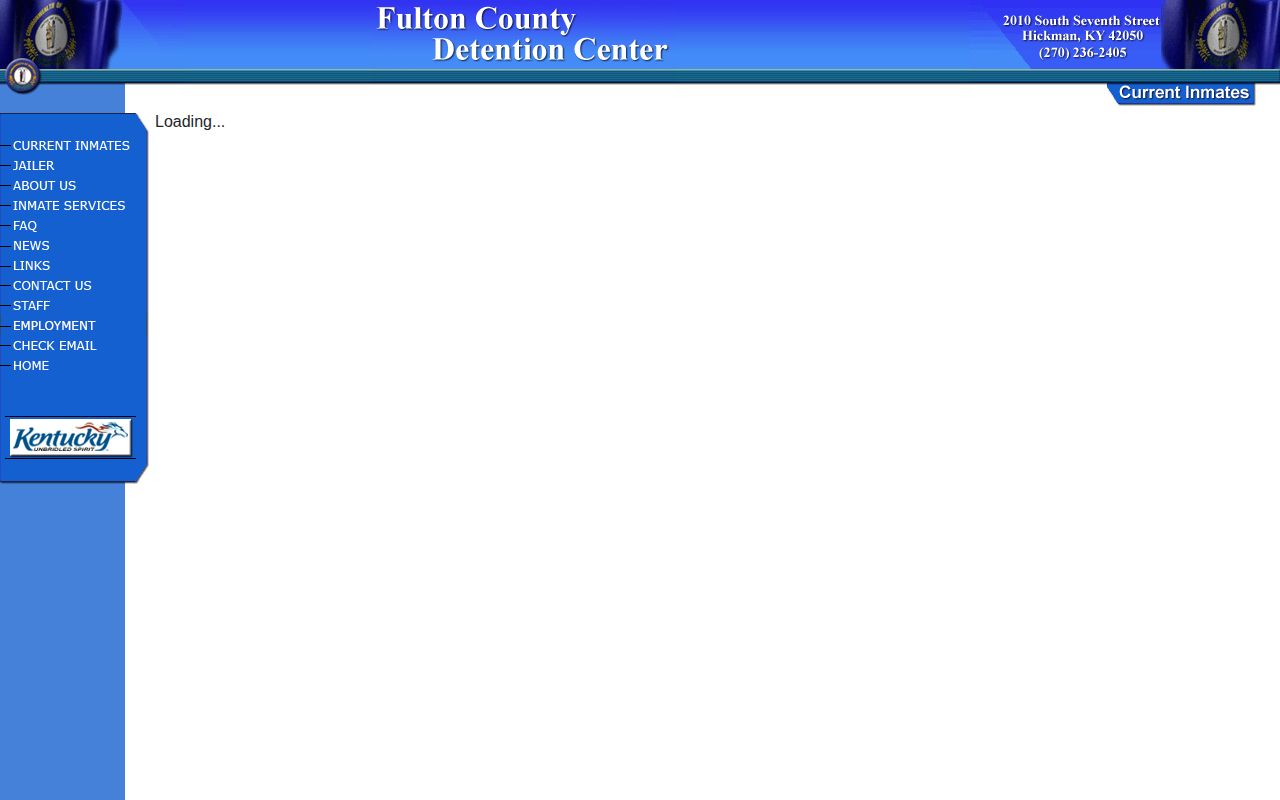
The image documents the page label, not a same-day release feed. A dated release sheet, VINE event, or court record must supply the missing release facts.
Check Fulton Same-Day Releases
Define the period before contacting FCDC. “Today” can mean midnight through the present, a calendar day, or the preceding 24 hours. A timestamped request prevents an event near midnight from falling outside the intended range. Use the person’s booking number if known because common names and aliases can create false matches.
- Write the exact start and end date and time, including the time zone.
- Call FCDC at 270-236-2405 and ask for the records custodian and accepted request method.
- Request the release transaction, booking number, release timestamp, coded reason, and receiving agency for any transfer.
- Check Kentucky VINE for the same person and read “release” and “transfer” as different events.
- Review the Fulton court docket for the order, then use DOC Daily Releases and KOOL if the person was state-tracked.
The county’s general open-records channel describes written requests and a five-business-day response route for Judge-Executive records. The Jailer is separately elected, so first confirm whether that county form or a distinct FCDC route applies. A narrow request is more useful than asking staff to create an undefined “release list.”
For a named-person lookup beyond one day, the Fulton County released inmate search explains how county, state, federal, and immigration records differ.
Note: Fulton has published no cadence for former-person visibility, so save the check time and rely on the custodian’s dated transaction.
Fulton Release Record Fields
No public Fulton feed guarantees a fixed set of columns. These are the specific fields supported by the research and appropriate to request from the record custodian. Their presence depends on what FCDC maintains and can lawfully release.
| Requested field | What it can establish |
|---|---|
| Name and booking number | Links the event to the correct local booking. |
| Release date and time | Records when FCDC processed the custody exit. |
| Release type or reason code | Distinguishes bond, court order, time served, or another reason. |
| Releasing facility | Identifies the agency whose transaction is being read. |
| Receiving agency | Shows whether departure was a transfer rather than community release. |
A court order and a physical release timestamp may differ. The order supplies legal authority. FCDC supplies the building-exit event. If a code is unclear, ask for its definition rather than translating it into a broader claim.
- Release
- A documented end to the named custodian’s confinement.
- Transfer
- Movement to another custodian, not freedom from custody.
- Time served
- Completion of the confinement period credited in the case.
- Detainer
- A request or hold that can prevent or redirect release.
Match Fulton Same-Day Identities
A same-day interval can contain people with similar names or several custody events for one person. Use the FCDC booking number first when it is available. For a state-tracked person, match the DOC or PID number between KOOL and the Daily Releases report. A Fulton court case number links the order to the correct prosecution. When only a name is known, check aliases, former surnames, age or date of birth, booking date, conviction county, and last confirmed facility.
Dates should form a sensible trail. The court order generally precedes or coincides with physical processing. The DOC daily entry should carry the same DOC number as KOOL. A VINE local-jail record and a DOC record can both belong to one person, but their event and facility labels should explain why. Do not resolve a same-name conflict from a photograph alone. Images can be old, missing, or tied to an earlier admission.
If the identifiers do not align, ask FCDC or the relevant custodian to clarify the record. A no-match after a spelling search is not proof that no release occurred. The person may appear under an alias, have a short stay that ended before the check, belong to another county, or have a record whose public access changed.
Fulton Property Bond Releases
Fulton County has a specific property-bond recording route. The Fulton County Clerk’s property-bond instructions require party information, the property address or legal description, and a certified copy of the bond and schedule of real estate from the Circuit Clerk. Those documents show that property was pledged as security.
Recording does not prove that FCDC completed a same-day release. Jail staff may still need the court order, identity checks, detainer review, and other processing. Confirm the court action with the Circuit Clerk and the actual custody exit with FCDC. When timing matters, ask for the release timestamp rather than using the bond-recording time as a substitute.
Fulton Release Cross-Checks
Kentucky VINE is the strongest person-specific public supplement. Search by partial name or jail/DOC identifier. Official state instructions say a not-in-custody result can provide the date released. A transfer event means the person left one facility for another, so it cannot be read as release to the community.
The Kentucky DOC Daily Releases sample shows DOC number, name, release type, and release location. It can list FCDC because the jail houses state-tracked people. It does not include every local bond release, dismissal, or short county-sentence release.
| Channel | Proper same-day use | Main limit |
|---|---|---|
| FCDC transaction | Confirms local exit time and type | Must be requested |
| VINE | Shows a person-specific custody event | Release and transfer must not be confused |
| Fulton court file | Explains bond, dismissal, sentence, or order | Order may precede physical processing |
| DOC Daily Releases | Checks state releases from FCDC | Not a complete county list |
| KOOL | Shows state status or supervision | Not every county detainee appears |
No official Fulton jailer or sheriff mobile app advertising recent releases was verified. The Sheriff and Jailer are separate elected offices, and FCDC release-record questions should begin with the Jailer.
Kentucky’s public systems can update on different schedules. KOOL is a state-status locator whose recent entries may not yet be final, while a DOC Daily Releases PDF is fixed to its stated publication date. VINE is an event and notification layer. For a same-day claim, give the FCDC transaction priority on its own physical release and use the other channels to explain state status, legal authority, or continuing supervision.
After a Fulton Release
Physical departure from FCDC is not always the end of legal control. A person may enter parole, probation, mandatory reentry supervision, a halfway-house placement, or another agency’s custody. Parole is conditional community release from a sentence. Probation is court-ordered supervision, often instead of confinement. Mandatory reentry is a state supervision status with its own terms.
A documented April 2026 case reported by 14 News illustrates the distinction. The report traced one person from FCDC to a ride to Madisonville, an intended Louisville halfway-house destination, and a later absconder warrant after he did not arrive. It was one case, not a general FCDC transportation policy.
The lesson is narrow but useful. A jail-door event, travel plan, destination arrival, and supervision compliance are separate facts. “Absconder” means an alleged failure to maintain required contact or comply with supervision. It does not mean successful discharge. Confirm each layer with its responsible agency.
Fulton Released Versus In Custody
A name on the live Fulton roster points to current local custody. A name absent from it proves only that the roster no longer displays the record. When VINE says released and provides a date, compare that event with FCDC’s transaction. When KOOL shows an active institution after the local name vanishes, the likely trail is a state transfer.
Federal and immigration custody require other systems. BOP’s locator covers sentenced federal custody. ICE’s locator is a current detention tool, not a verified historical Fulton release ledger. No single database covers all layers. The legal custodian controls its own event, and the Fulton court file explains the order behind many local releases.
Widen the Fulton Release Window
A same-day check is useful when the expected event is recent and the interval is exact. If the time is uncertain or crosses several dates, use the Fulton County 72-hour releases workflow. That page focuses on a three-day interval and weekend or holiday boundaries.
Do not build the wider answer by comparing screenshots and assuming every disappeared name was released. Ask FCDC for the defined interval, then verify each event through VINE, court records, and state records as needed. This keeps transfers and corrections out of the release count.