
Federal Release Destinations Explained
A sentenced federal prisoner can leave a BOP institution for the community, a residential reentry setting, another custodian, or a status involving federal supervised release. Supervised release is court-ordered monitoring after confinement and is not the same as BOP custody. A person can also finish BOP custody and enter state, local, or immigration detention.
The BOP Inmate Locator uses “Released” or “Not in BOP Custody” when the person is no longer held by BOP. Those phrases do not rule out every other form of custody or supervision. They also do not cover every federal pretrial person held for the U.S. Marshals Service.
| Federal situation | Primary source | Meaning |
|---|---|---|
| Sentenced BOP custody | BOP locator | Federal location or release status |
| Pretrial Marshals custody | Federal docket and named facility | Current detention authority |
| After confinement | Federal judgment or probation office | Supervised-release term |
| Immigration transfer | ICE locator and case confirmation | Separate civil custody |
Confirm Federal Inmate Release
Identifier search is the most reliable BOP route. The locator accepts a BOP Register number, DCDC number, FBI number, or INS number. Name search can also use race, age, and sex. Results may display the name, register number, age, race, sex, release date, and location.
- Search by federal identifier when one is known.
- Match the full name, age, and register number.
- Record the exact location or release label and date.
- Read the federal docket for sentence and supervision terms.
- Check another custodian when the facts suggest a transfer or hold.
BOP cautions that First Step Act recalculation can affect displayed dates. Recheck the official locator when timing matters. A projected date is not the same as an actual departure, and release from confinement is not always the end of federal court supervision.
The official BOP locator interface appears below.
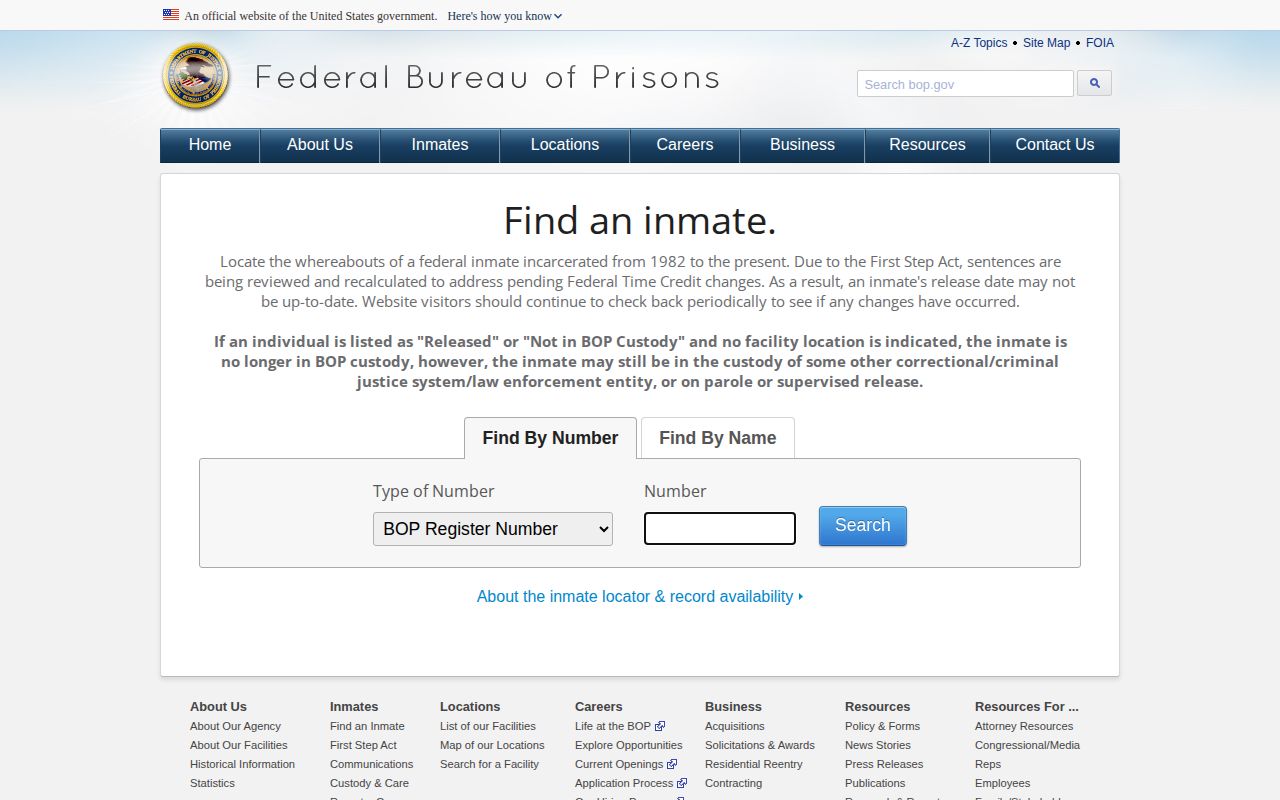
The locator supplies federal custody fields, but the docket remains the stronger source for the legal sentence and supervised-release term.
Fulton Federal Custody Limits
The August 2025 Kentucky DOC jail report counted zero federal inmates at FCDC. That is a dated snapshot, not a permanent ban on federal detention. Research found no federal BOP institution in Fulton County and no basis for presenting the county roster as a federal release archive.
If FCDC says a person was transferred to a federal authority, ask for the receiving agency and destination. Search BOP only when sentenced BOP custody fits the facts. For a Marshals detainee, use the federal case docket, named detention site, defense counsel, and an appropriately directed records request. No public USMS historical released-person locator was verified.
Federal Release Record Sources
The federal judgment can show the term of imprisonment and supervised release. Docket entries may record a release-related court order or later violation proceeding. They may not state the exact minute a facility completed release processing. For that event, use the BOP result and the responsible facility or agency record.
A BOP release date can be corroborated with the docket, but each document answers its own question. The locator reports custody status. The judgment supplies legal terms. A federal probation office addresses supervision. ICE addresses immigration detention. Avoid merging these into one generic “federal release record.”
- BOP custody
- Sentenced federal confinement administered by the Bureau of Prisons.
- USMS custody
- Marshals control often involving pretrial or transported detainees.
- Supervised release
- Court-ordered monitoring after federal confinement.
- Detainer
- A request or hold from another authority that may redirect release.
Federal Records And Contact
The BOP locator is the public starting point, and its result should be saved with an access date because custody data changes. For a detailed record, follow BOP's official records instructions or request the relevant federal court document. Identify the person by register number and give a narrow date range.
Federal Bureau of PrisonsNationwide federal institutions
Public starting point: BOP Inmate Locator
Use the institution or BOP records channel for case-specific custody data
No local Fulton BOP office or institution was established. County officials cannot certify a nationwide BOP status. Conversely, BOP cannot certify a Fulton jail release that never entered BOP custody. The custody-specific paths on Fulton County Released Inmates help separate those questions.
After Federal Confinement Ends
When the locator says “Released,” inspect the federal judgment for supervised release and the docket for later changes. Do not treat BOP release as full sentence discharge without that check. If the person moved into immigration custody, use the Immigration detention facilities route. If state custody followed, use Kentucky Department of Corrections institutions statewide.
A name-only mismatch deserves more research, not a guess. Aliases, transposed names, and older records can cause confusion. Match the register number and federal case whenever possible, and report any unresolved conflict with both source labels intact.
Federal Release Date Conflicts
Several federal dates can be valid at once. The judgment starts the legal record. A projected BOP date can change with recalculation. Physical departure ends confinement at a named institution. Supervised release begins a separate court-controlled phase. A transfer can move the person without community release.
Record each date label. If BOP changes a result, retain the access date and check the docket. The First Step Act warning means an old locator result is not immutable. The court controls its order, while BOP controls its confinement transaction.
A Fulton County connection does not mean the person was held in Fulton. Use the actual institution shown by BOP and its official records route. Do not invent a local federal address or county federal roster.
BOP Locator Result Meaning
The BOP locator covers sentenced federal records within its published scope, including many releases from 1982 forward. It is not a universal federal detainee database. A person awaiting trial may remain in U.S. Marshals custody at a local or contract jail and never appear as a current BOP inmate. The federal docket and named detention facility are better sources for that stage.
Released and Not in BOP Custody are BOP-specific. Either can coexist with state custody, local custody, immigration detention, parole, or federal supervised release. When another hold is plausible, search the receiving system. Do not shorten the label to free, because that discards the agency boundary that gives the result meaning.
Identifier searches reduce false matches. A BOP Register number is preferable to name alone. DCDC, FBI, or INS identifiers may also work. If only a name is known, combine it with available age, race, and sex fields, then compare the result to the federal case.
Federal Court Release Trail
The federal judgment identifies imprisonment and any term of supervised release. Later docket entries can document sentence changes, release orders, violations, or revocation. The court file explains legal authority, while BOP is stronger for the custody transaction. Neither should be forced to certify the other agency act.
Supervised release begins after confinement under the judgment and is administered through the federal court and probation system. It is distinct from Kentucky parole and BOP custody. A person can be released by BOP yet remain subject to federal court conditions. Check the docket before calling the sentence complete.
If the person was a Marshals detainee, identify the actual facility. No verified public USMS historical release locator was found. Use the docket, defense counsel, named detention site, and a properly directed request. A county roster disappearance is not an adequate substitute.
Federal Transfers From Fulton
A dated state report found no federal inmates at FCDC in August 2025. It does not prove federal holds or transfers can never occur. If FCDC identifies a federal departure, request the receiving agency and transaction type. A transfer from the county jail begins the federal search; it does not establish federal release.
When BOP custody later ends, check ICE ODLS if immigration control is indicated. When Kentucky custody follows, use KOOL. Each locator covers a limited legal population, and absence from one says little about another. Preserve access dates because live results change.
Federal Identity Reconciliation
Federal name searches require care with aliases, initials, and common transpositions. Match the register number and federal case number before accepting a result. Age, race, sex, sentence date, and institution can support the match, but no one secondary field should override a conflicting identifier.
A release date also needs its source label. The BOP locator date describes the federal custody record. A docket order can explain legal authority. A probation record addresses post-confinement supervision. When these sources disagree, preserve each date and ask the office that created the disputed transaction.
Records can change after recalculation or correction. Save the access date, then recheck the official locator. An old screenshot is evidence of what the system displayed at that time, not a permanent certification of current status.
When a federal result cannot be reconciled, state the conflict instead of selecting one date. Provide the BOP register number, locator access date, docket number, and named institution to the relevant office. Those details allow BOP or the court to locate its own record and explain whether recalculation, transfer, or a later order changed the public trail.
Public Record Search
Sponsored Results